
Danbury Criminal Court Records
Danbury criminal cases are handled through the Connecticut Superior Court structure. The Superior Court is the state trial court of general jurisdiction. Danbury Judicial District and G.A. 3 both operate at 146 White Street. G.A. 3 at Danbury is important for arraignments, misdemeanors, many motor vehicle matters, and criminal daily dockets. More serious criminal matters may proceed through the Judicial District side. The same building can appear in both paths, so the docket number, case type, and court location determine the correct record route.
A criminal court record is broader than one charge. It can include the charging document, docket number, arraignment, release or bond conditions, appearances by counsel, motions, continuances, hearings, pleas, trial activity, verdict, disposition, sentence, probation, and post-judgment events. For a closer look at the arrest-to-charge step before the full case outcome, use the Danbury arrest records and court charges page.
Case flow: Charges filed › arraignment › pretrial hearings and motions › plea or trial › disposition › sentencing and probation where ordered.
Search Danbury Criminal Court Records
The Connecticut Judicial Branch criminal and motor vehicle lookup menu is the main public path. It links to arrest warrants, sentence review docket, motions to seal or close, convictions by defendant, convictions by docket number, daily docket by court, daily docket by defendant, pending case by defendant, pending case by docket number, and attorney or firm lookup by juris number. Use the pending search when the case is still open. Use conviction searches when the goal is an adult public conviction result within display limits.
- Open the criminal and motor vehicle lookup menu and choose pending case, conviction, daily docket, or docket-number search.
- Search by defendant last name, first initial, birth year, year range, court location, and category type when those fields are offered.
- Select a Danbury court location such as D03D-Danbury Geographical Area 3 when the case is known to be local.
- Review the defendant, docket number, court, charge list, case status, next court date, disposition, and sentence information where displayed.
- Contact the Clerk of the Superior Court when a document is sealed, not online, too old for display, or needed as a certified copy.
The Judicial Branch criminal and motor vehicle lookup menu is the source for this image.
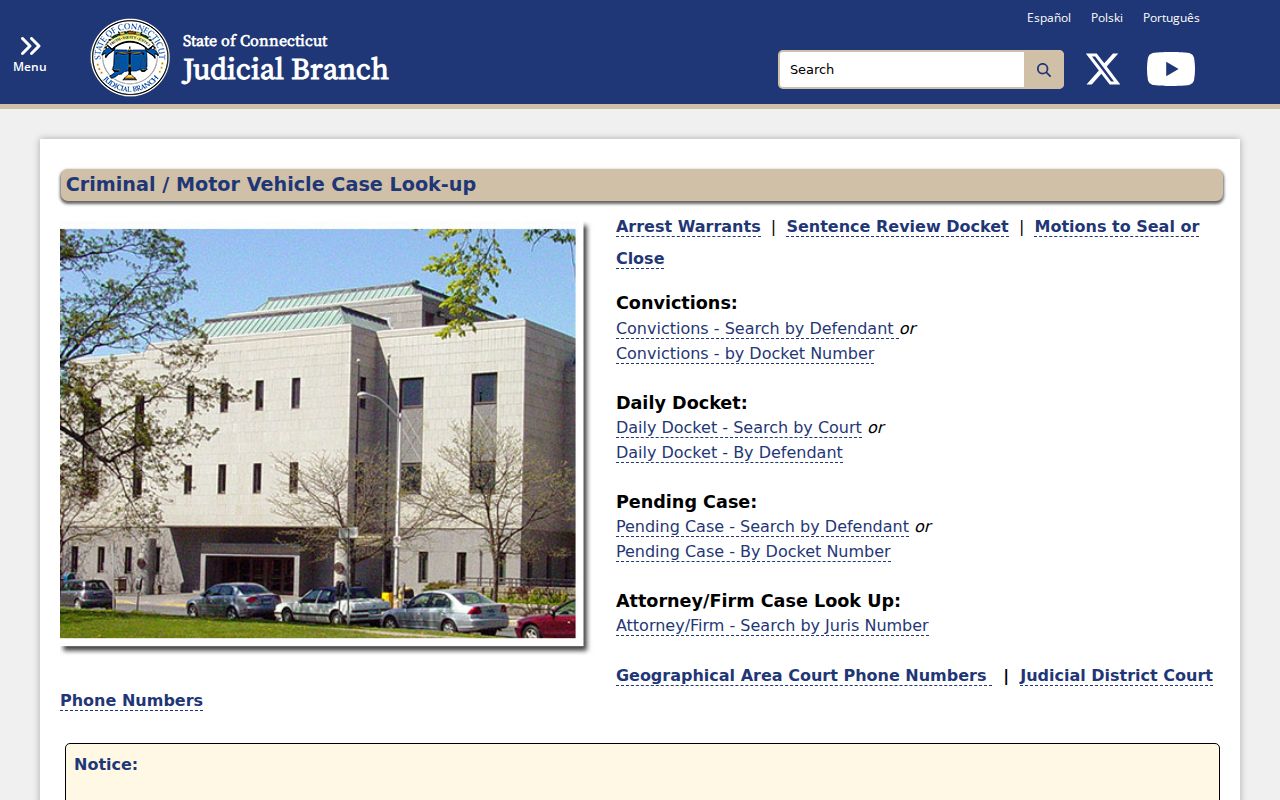
The menu is the practical starting point because Danbury criminal court records are split among pending, conviction, docket, daily calendar, warrant, and sealing tools.
What Danbury Criminal Records Show
Criminal case results are read field by field. A name alone is not enough because statewide searches can return people with similar names. The court location, docket number, birth year when available, charge text, status, and event dates should be compared before the result is treated as a match. The public display may change after erasure, correction, pardon, or other modification, and some records never appear in the public search.
| Field | What It Shows |
|---|---|
| Defendant | The person charged in the criminal or motor vehicle case. |
| Docket or case number | The unique court identifier used by the clerk and lookup systems. |
| Court location | Danbury Judicial District or D03D-Danbury G.A. 3 when the case is local. |
| Charges | The offenses filed by the State's Attorney, which may change during the case. |
| Case status | Whether the matter is pending, disposed, continued, or otherwise marked by the court. |
| Next court date | The next listed appearance or calendar event when publicly available. |
| Disposition | The outcome, such as guilty plea, finding, dismissal, nolle, or other resolution. |
| Sentence | Penalty terms after conviction, including incarceration, probation, or other court orders where shown. |
The Judicial Branch conviction search by defendant is the source for this capture.
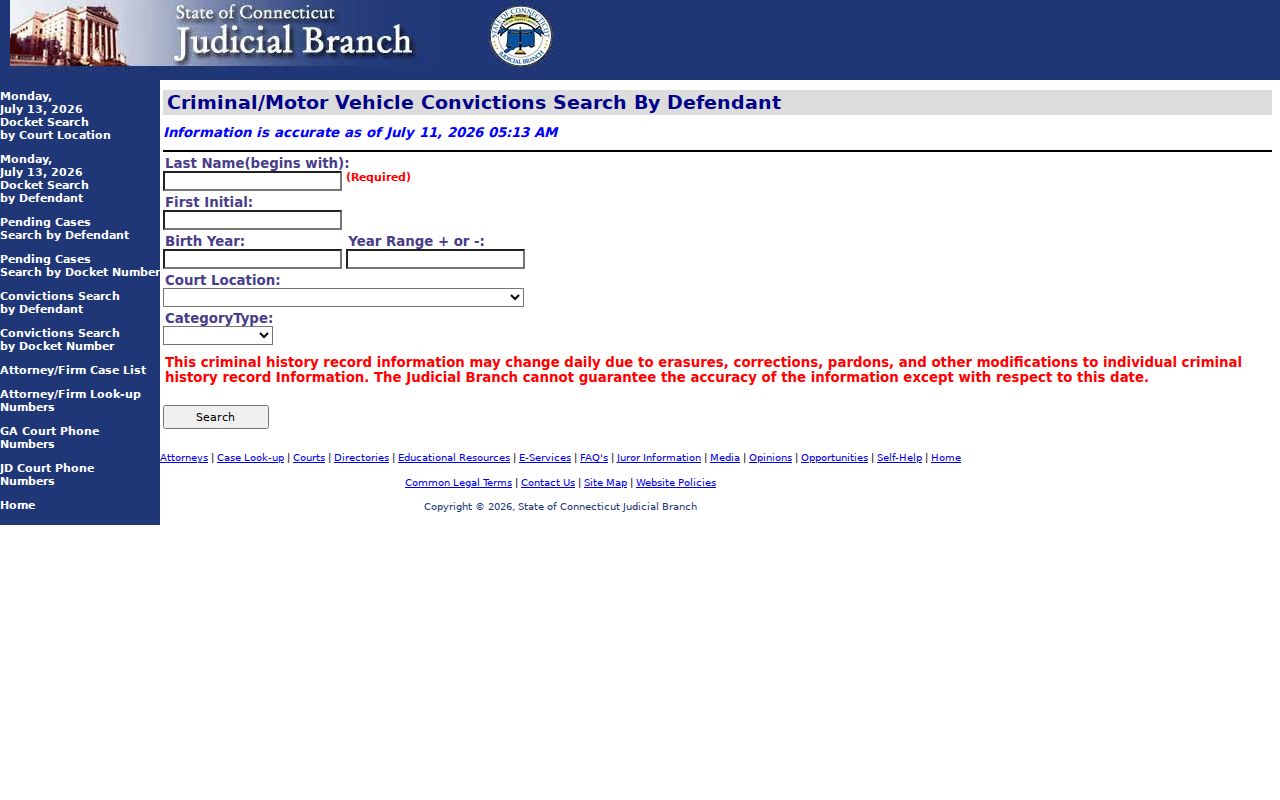
Conviction searches should be read with the Judicial Branch display limits in mind, especially the stated time limits and exclusions.
Danbury Charges vs Convictions
A charge is an accusation filed in court. A conviction is an outcome after a guilty plea, guilty finding, or other judgment that results in guilt. This difference matters because Danbury arrest records, charging records, pending criminal dockets, and conviction searches do not answer the same question. A pending charge can later be amended, reduced, nolled, dismissed, erased, or resolved by plea or trial. A conviction search should not be used as a complete arrest history or as proof that no case ever existed.
| Charge | Conviction | |
|---|---|---|
| Stage | Filed after arrest or investigation. | Entered after guilty plea, verdict, or qualifying finding. |
| Record path | Pending case, docket, daily calendar, or charging document. | Conviction by defendant or docket number where public display permits. |
| Meaning | An allegation that must still be resolved. | A final or reportable outcome showing guilt. |
| Can change? | Yes, it may be amended, reduced, dropped, dismissed, or nolled. | Yes, later correction, pardon, erasure, or appeal activity can affect display. |
Danbury State's Attorney Records
Connecticut uses State's Attorneys, not district attorneys. The Division of Criminal Justice is an independent executive-branch agency responsible for the investigation and prosecution of criminal matters in Connecticut. It includes the Office of the Chief State's Attorney and State's Attorney offices for the thirteen judicial districts, including Danbury. Prosecutor files are not the same as public court files, and court docket access still runs through Judicial Branch lookup and the Clerk of the Superior Court.
The Judicial District of Danbury State's Attorney is David Applegate at 146 White Street, telephone 203-207-8670. The G.A. 3 at Danbury Supervisory Assistant State's Attorney is Deborah Mabbett, with the same listed phone and fax 203-207-8684. The prosecutor files and prosecutes criminal charges after arrest, handles plea negotiations, dispositions, sentencing recommendations, and some post-conviction matters. Public access to prosecutor work product can be more limited than access to ordinary court docket events.
The Division of Criminal Justice overview is the source for this image.
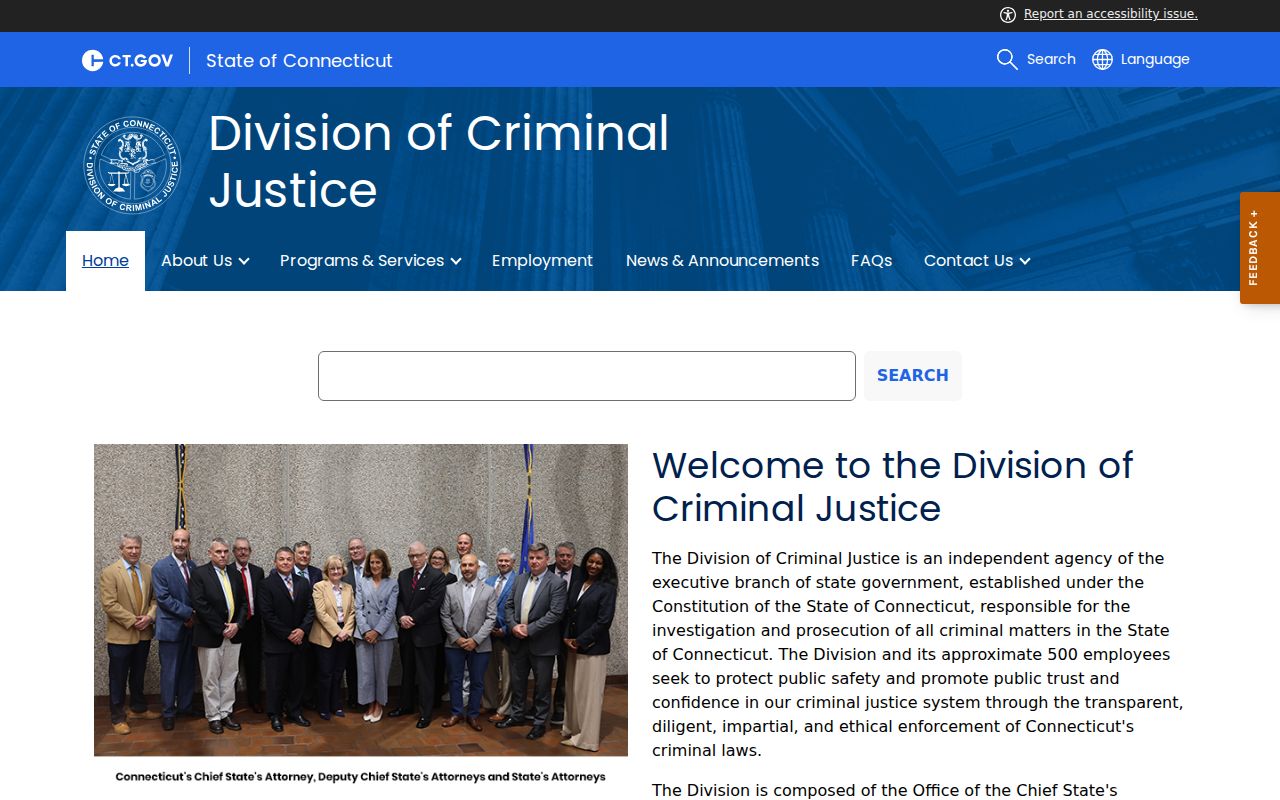
This source confirms why Danbury criminal court records should use State's Attorney terminology rather than county district attorney wording.
Danbury Public Defender Context
The Public Defender Danbury J.D. and G.A. 3 office is at 146 White Street. The supervisor listed in the research is James Lamontagne, telephone 203-207-8650, fax 203-207-8660. Public defender information matters because counsel can be appointed at arraignment or after financial eligibility review. It does not create a public records counter for non-clients, but it is a key contact for represented defendants and families who need case, plea, court date, or sentence context.
The Office of Chief Public Defender page warns that public defenders do not call asking for money or credit card information, and such calls are scams. That warning is relevant when families search Danbury criminal court records after an arrest and receive payment demands from unknown callers. Public court data should be checked through Judicial Branch systems, the clerk, counsel, or a verified court contact.
The official Danbury Public Defender office page is the source for this image.
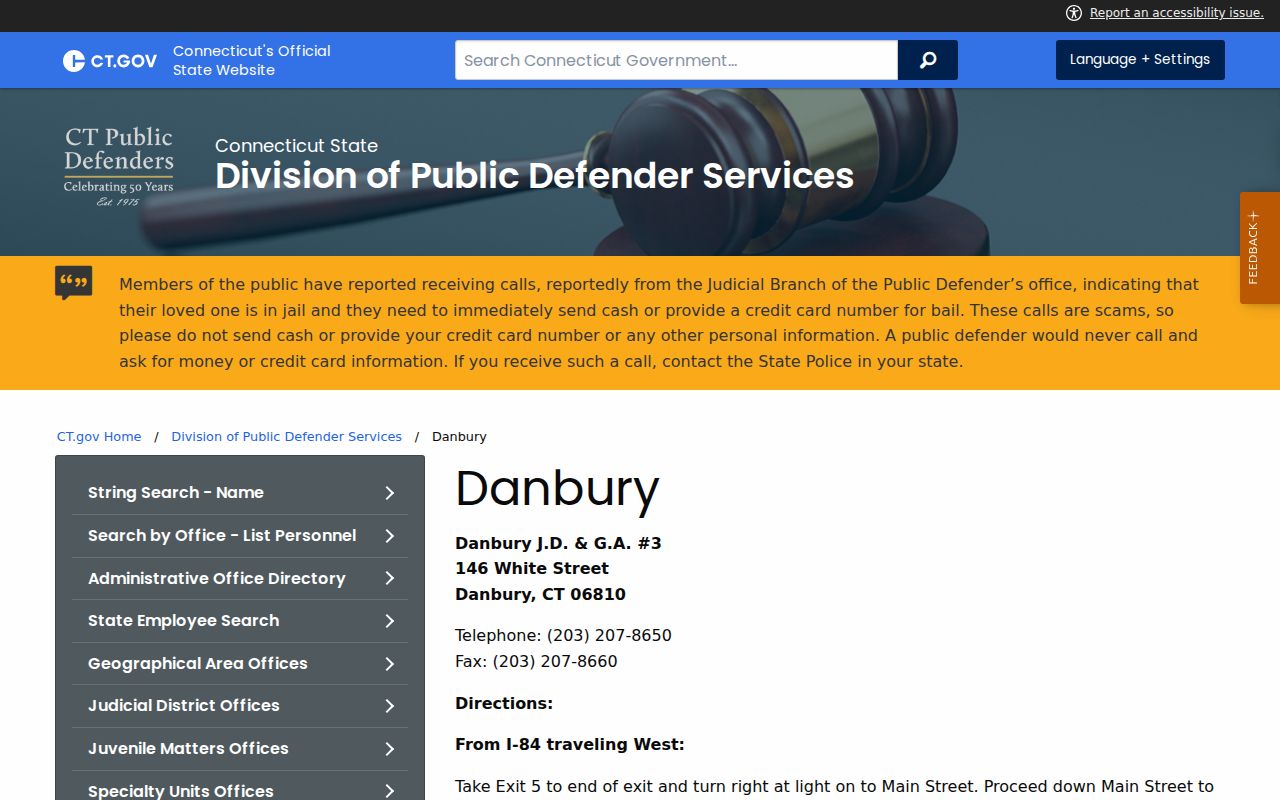
The contact page helps users distinguish legal representation contacts from the court clerk record request path.
Sealed and Erased Danbury Records
Restricted criminal records require careful reading. Juvenile cases and Youthful Offender cases are not shown in public criminal and motor vehicle conviction lookup. Infraction and violation convictions are also excluded from that conviction display. Connecticut erasure law, including C.G.S. 54-142a, removes qualifying dismissed, not guilty, pardoned, or otherwise eligible criminal records from ordinary public criminal-history treatment. Sealing and closure follow court rules and may require formal motions and findings.
| Sealed Record | Erased Record | |
|---|---|---|
| Basic effect | Hidden from ordinary public view by statute or court order. | No longer treated as public criminal history when statutory requirements apply. |
| How it happens | Often through court-rule procedures and findings. | Through Connecticut erasure law, pardons, dismissals, not-guilty outcomes, or other qualifying events. |
| Public lookup | May show limited information or nothing. | May disappear from public display after processing. |
| Practical step | Contact the clerk or counsel for access rules. | Verify with the court, counsel, or official state process rather than relying only on a search result. |
The Connecticut criminal records chapter is the source for this statutory image.
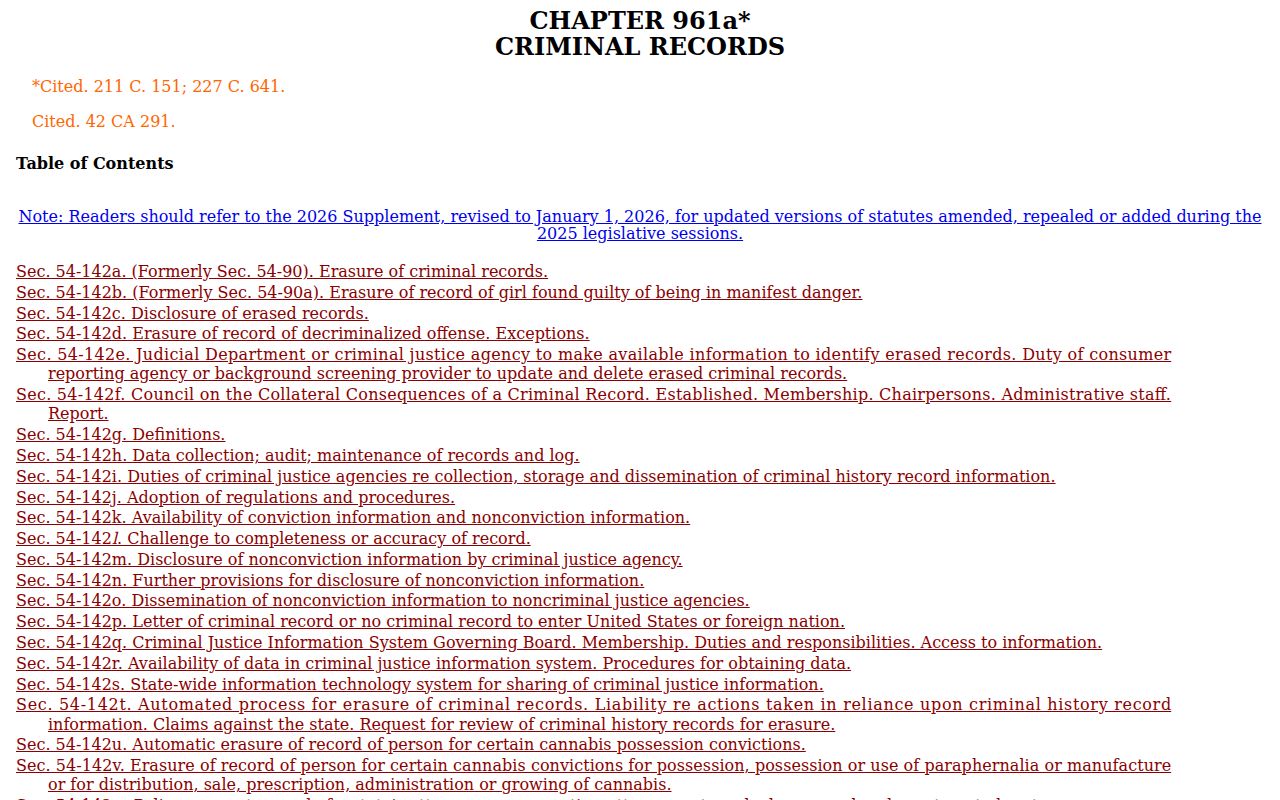
The erasure statute explains why a public Danbury criminal court records search may change after dismissal, pardon, or another qualifying event.
Public Access Limits
Criminal records are public only to the extent allowed by court rules, statutes, and display policies. The Judicial Branch notice says criminal history information may change daily because of erasures, corrections, pardons, and other modifications. It also warns that public online conviction display is limited in time and scope. A missing result may mean no public online display, not no record. A visible charge may be pending, amended, or later resolved in a way that changes its public status.
For the full record path, start with the online criminal and motor vehicle lookup. Then use the docket number when contacting the clerk at 146 White Street. Police arrest logs and reports can be requested through Danbury Police, but they are not final court outcomes. The broader Danbury court records overview explains when civil, family, probate, police, Town Clerk, DMV, or DOC channels are better sources.
Public Record Search
Sponsored Results